Sunday, January 24, 2016

Business Cycles


  • 1 cycle occurs from trough to trough
  • Cycle avg. 5 - 7 years
  • Recessions last approx. 14 months
  • Peaks and troughs meaningless b/c we never know we are in one until its over
  • Trough = end of recession
  • Recession lose >10% of real GDP -> Depression
Peak - Highest point of real GDP; shows max amount of spending and min unemployment; inflation is a problem.

Expansion (recovery) - Real GDP up b/c of increase in spending and decrease in unemployment.

Contraction/Recession - Real GDP down for 6 months; unemployment up & spending down

Trough - Lowest point of Real GDP: max unemployment and min spending

Supply and Demand

Demand


Demand is the quantities that people are willing and able to buy at various prices

Law of Demand - Inverse relationship between price and quality demanded
  • Change in price changes the change in quantity demanded
Causes of change in demand
  • Change in...
    • buyers' taste
    • # of buyers
    • income
      • Inferior goods - increase in income -> decrease or no change in demand
      • Informal goods - increase in income -> increase in demand
    • price of related goods
      • Complementary goods - goods that pair well
      • Substitute goods - replacement for similar goods
    • expectations

Supply


Supply is the quantities that producers or sellers are willing and able to produce at various prices

Law of Supply - Direct relationship between $ and quantity supplied
  • Change in price causes a change in quantity supplied.
Causes of change in supply
  • Change in...
    • weather
    • tech
    • cost of production
    • # of sellers
    • taxes/subsidies
    • expectations
Why the curve moves left
  • Supply down
  • Increase in cost of production
  • Technology down
  • Taxes up
  • Subsidies down
  • # of sellers down
  • Weather conditions are worse
Why the curve moves right
  • Supply up
  • Cost of production down
  • Technology up
  • Taxes down
  • Subsidies up
  • # of sellers up
  • Weather conditions are good

Elasticity of Demand


  • Elasticity of Demand - Measure of consumers' reaction to price changes
    • Elastic - Sensitive demand from price change; E > 1; Not a necessity, some substitutes
      • Ex: sodas, steaks, candy, fur coats 
    • Inelasic - Demand not vulnerable to price change; E < 1; necessary product; few to no substitutes; always bought
      • Ex: Insulin/Medicine, Salt, Gas, Milk
    • Unit/ary - E = 1
Calculation
  1. Quantity - (New Q - Old Q) / Old Q
  2. Price - (New $ - Old $) / Old $
  3. PED - % change Q dem./ % change $ = |PED|


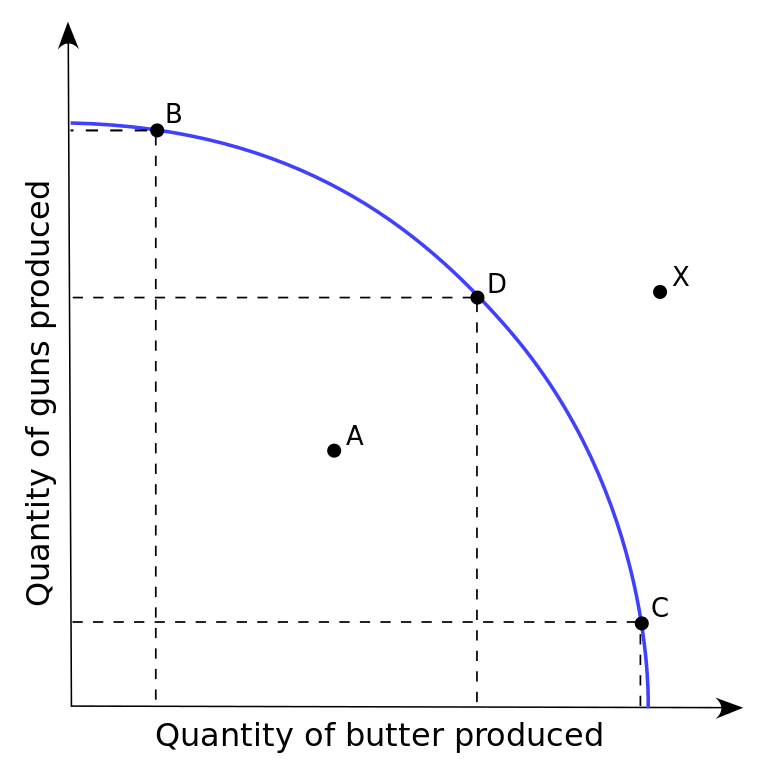
Production Possibilities Curve

B, D, C - Attainable and efficient
A - Attainable yet inefficient (underutilization)
X - Unattainable in current state

Also known as the PPC, PPF, or PPG

The PPC shows alt. ways of resource usage

4 Assumptions
  1. 2 goods
  2. Fixed resources
  3. Fixed technology
  4. Full employment of resources
Efficiency
  • Efficiency - Max usage of resources; little wasted
  • Allocative - Products produced most desired by society
  • Productive - Products produced w/ least cost; any point on curve
  • Underutilization - Using fewer resources than economy's capability
Movements of the PPC
  1. Inside PPC - when resources are unemployed
  2. Along PPC - on curve
  3. Shifts of PPC
    • Increase - graph moves ->
    • Decrease - graph moves <-
Causes of Shift
  1. Tech change (Out)
  2. Resource change (Out)
  3. Economic growth
  4. Natural disasters/war/famine (In)
  5. Labor change (In)
  6. Increase in education & training (Human capital) (In)

Unit 1 Miscellaneous

Macro vs. Micro

  • Macroeconomics - Study of economics as whole {International trade, Supply and Demand, and minimum wage}
  • Microeconomics - Study of individual/specific units of economy {Market struc., Business org.}


Positive vs. Normative Economics

  • Positive - Tries to describe current world, descriptive; "What is...", Collects and presents facts
  • Normative - Tries to prescribe expectations of the world; represented by "ought" and "should"


Needs vs. Wants

  • Needs - Basic requirements for survival

    1. Food
    2. Water
    3. Shelter
    4. Clothing

  • Wants - Desires of citizens


Goods vs. Services

  • Goods - Tangible commodities

    • Capital goods - Materials for other goods (trucks, machinery, factories) 
    • Consumer - Final product to be used by customer
  • Services - Work performed for someone

Scarcity vs. Shortage

  • Scarcity - Fundamental economic problem society faces; how to satisfy unlimited wants w/ resources.
  • Shortage - Quantity demanded > Quantity of supply

4 Factors of Production
  1. Land 
  2. Labor
  3. Capital
    • Physical - Tools, buildings, factories, machinery
    • Human - Skills, abilities, intellect, talent
  4. Entrepreneurship - (Req innovation and risk taking)
Trade-offs - Alt. we give up whenever we choose something over another
Opportunity cost - Next best alt. what to give up
Total revenue - Total $ a firm receives from selling
Fixed cost - Cost resistant to change no matter the amount produced

  • Ex: mortgage, rent, salary, insurance
Variable cost - cost rises/falls based on # produced. Ex: Bills
Marginal cost - cost of producing one more unit.