Absolute Advantage
- Individual- When a person can produce more of a certain good/service than someone else in the same amount of time (or can produce a good using the least amount of resources).
- National- When a country can produce more a good/service than another country can in the same time period.
Comparative Advantage
- A person or a nation has a comparative advantage when it can produce the product at a lower domestic opportunity cost than can a trading partner.
- Examples of output problems
- Words per minute
- Miles per gallons
- Tons per acre
- Apples per tree
- Televisions produced per hour
- Examples of input problems
- Number of hours to do a job.
- Number of acres to feed a horse
- Number of gallons of paint to paint a house.
Specialization and trade
- Gains from trade are based on comparative advantage, not absolute advantage.
Mechanics of the Foreign Exchange (FOREX)
- Buying and selling of currency.
- Any transaction that occurs in the balance of payments necessitates foreign exchange.
- The exchange rate (e) is determined in the foreign currency markets.
Changes in exchange rates
- Exchange rates (e) are a function of the supply and demand for currency.
- Increase in the supply of a currency will decrease the exchange rate of a currency.
- Decrease in supply of a currency will increase the exchange rate of a currency.
- Increase in demand for a currency will increase the exchange rate of a currency.
- Decrease in demand for a currency will decrease the exchange rate of a currency
Appreciation and depreciation
- Appreciation occurs when exchange rate of that currency increases. (e increases)
- Depreciation occurs when exchange rate of that currency decreases (e decreases)
- Determinants of Exchange rate:
- Consumer tastes (buyers taste)
- Relative income
- Relative price level
- Speculation
Exports and imports
- The exchange rate is a determinant of both exports and imports.
- Appreciation of the dollar causes American goods to be relatively more expensive and foreign goods to be relatively cheaper, thus reducing exports and increasing imports.
- Depreciation of the dollar causes American goods to be relatively cheaper and foreign goods to be relatively more expensive, thus increasing exports and reducing imports.
- As two currencies trade:
- One supply line will change; the other demand line will change.
- They will move in the same direction.
- One currency will appreciate, the other will depreciate.
- Flexible rate - Based on the supply and demand of that currency versus the other currency. It is very sensitive to the business cycle and it provides options for investment.
- Fixed rate - Based on country's willingness to distribute currency and to control the amount.
The Balance of Payments
- Measures of money inflows and outflows between the united states and the rest of the world (ROW).
- Inflows = credits
- Outflows = debits
- The balance of payment is divided into three accounts:
- Current account
- Capital/financial account
- Official reserves account
Current account
- Balance of trade or Net exports
- Exports of goods/services- import of goods/services.
- Exports create a credit to the balance of payments.
- Imports create a debit to the balance of payments.
- Net foreign income
- Income earned by the U.S. owned foreign assets
- Interest payments on U.S. owned foreign assets- Interest payments on German-owned U.S treasury bonds.
- Net transfers (tend to be Unilateral)
- Foreign aid- a debit to the current account.
- Ex - Mexican migrant worker sends money to family.
Capital / Financial Account
- The balance of capital ownership.
- Includes the purchase of both real and financial assets
- Direct investment in the United States is a credit to the capital account.
- For example the Toyota company in San Antonio.
- Direct investment by United States firms/individuals in a foreign country are a debit to the capital account.
- Intel factory construction in Germany
- Purchase of foreign financial assets represents a Debit to the capital account.
- Warren buffets buys stock in Petrochina.
- Purchase of domestic financial assets by foreigners represents a credit to the capital account.
- The UAE sovereign wealth fund purchases a large stake in the NASDAQ.
Relationship between current and capital account
- Current account and capital account zero each other out.
- If current account has a negative balance (deficit) then capital account should have a positive balance (surplus).
Official reserves
- Foreign currency holdings of the U.S. fed.
- When there is a balance of payments surplus, fed accumulates foreign currency and debits the balance of payments.
- When there is a balance of payments deficit, fed depletes its reserves of foreign currency and credits the balance of payments.
Active v. passive official reserves
- The U.S. is passive in its use of official reserves. It does not seek to manipulate the dollar exchange rate.
- The People's Republic of China is active in its use of official reserves. It actively buys and sells dollars in order to maintain a steady exchange rate w/ the United States.
Formulas
- Balance of trade = Good exports + goods imports
- Balance on goods & services = Goods exports + service exports + goods imports + service imports.
- Current Account = Balance on goods and services + net investment + net transfer
- Capital account = Foreign purchases + domestic purchases.
- SRAS - Wages fixed as $ fluctuates
- LRAS - Wages responsive to ∆ in PL
- Effects - SR - > PL ∆ allow firm to exceed normal outputs and labor since profits up
- LR -> Wages adjust to PL; previous output levels follow.
- Extended Model - Both SRAS and LRAS; LRAS vertical @ full employment
Inflation
- Demand-pull - Price up based on AD (Right)
- SR - $ up, Prod. up
- LR - AD increases subside
- Cost-push - Left, inc. in per unit costs (up in res. $); Cause of PL increase
- Gov. dilemma
- Wait - Recession (Prod. and Employ. down)
- Action - Inflationary Spiral
Phillips Curve
- Long Run Phillips Curve - Vert @ natural rate of unemployment
- Struc changes in Un also shifts LRPC
- Inc in Un LRPC ->
- Dec in Un LRPC <-
- No trade off b/t inflation and unemployment
- Occurs at Un; Rep by up or down
- Assumption - More worker benefits create higher natural rates vice versa for less
- Short Run Phillips Curve - Tradeoff b/t inflation and unemployment
- Supply Shocks - Rapid and significant increase in resource cost (SRAS left; SRPC right)
- Misery Index - Combo of inflation and unemployment in any given year. 0-9 good
- Inflation - General rise in PL
- Deflation - General decline in PL
- Disinflation - Decrease in rate of inflation over time
- Stagflation - Inflation and unemployment increase @ same time
Reaganomics
- ∆ in AS, not AD -> Determines inflation level, unemployment rates, and econ. growth
- Supply side economics support policies that promote GDP growth by arguing that high marginal tax rates along with current system of transfer payments (unemployment comp or welfare program) provide disincentives to work invest, innovate, and undertake entrepreneur ventures
- Low marginal tax rates induce more work -> AS up
- Leisure more costly, work more attractive
- Incentives to save and invest
- High marginal tax rates reduce rewards for saving and investment
- Consumption might increase; investment depends on savings
- Lower marginal rates encourage saving and investing
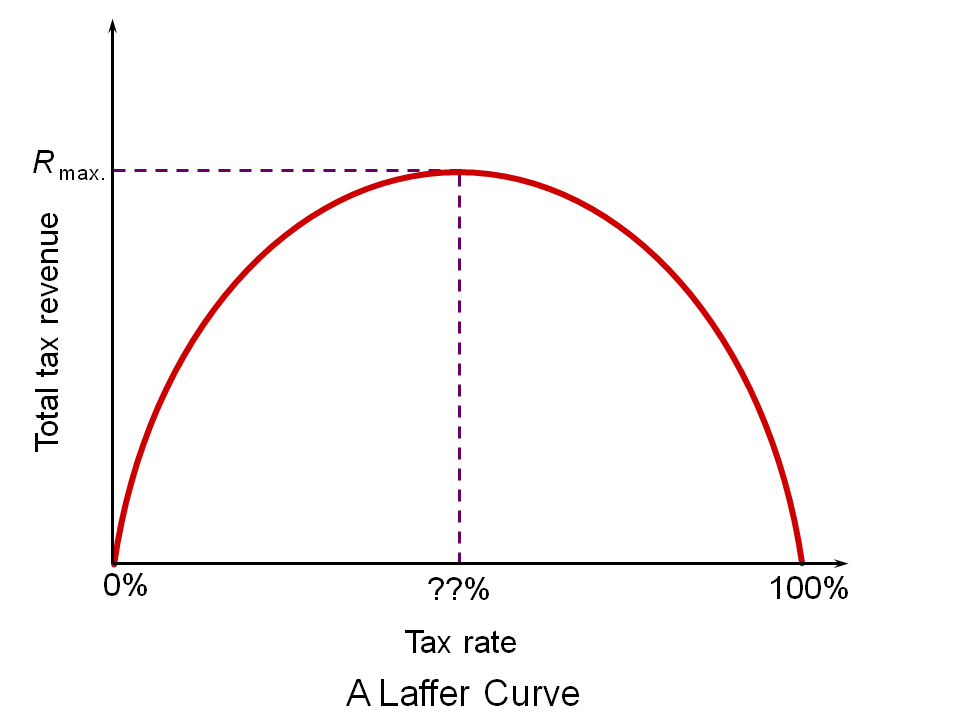
- Laffer Curve - Theoretical relationship b/t tax rates and gov revenue
- As tax rates increase from 0, tax revenues increase from 0 to some max point and then decline
- Criticisms
- Research suggests impact of tax rates on incentives to work, save, and invest are small
- Tax cuts increase demand -> fuel inflation and demand can exceed supply
- Economy's real location on curve difficult to determine


.jpg/138778625/Foreign_Exchange_Market_(Supply_Shifts).jpg)