Monday, May 16, 2016

Absolute and Comparative Advantage


Absolute Advantage

  • Individual- When a person can produce more of a certain good/service than someone else in the same amount of time (or can produce a good using the least amount of resources).
  • National- When a country can produce more a good/service than another country can in the same time period.

Comparative Advantage

  • A person or a nation has a comparative advantage when it can produce the product at a lower domestic opportunity cost than can a trading partner.
  • Examples of output problems
    • Words per minute
    • Miles per gallons
    • Tons per acre
    • Apples per tree
    • Televisions produced per hour
  • Examples of input problems
    • Number of hours to do a job.
    • Number of acres to feed a horse
    • Number of gallons of paint to paint a house.

 Specialization and trade

  •  Gains from trade are based on comparative advantage, not absolute advantage.

Mechanics of the Foreign Exchange (FOREX)

  • Buying and selling of currency. 
  • Any transaction that occurs in the balance of payments necessitates foreign exchange.
  • The exchange rate (e) is determined in the foreign currency markets.

 Changes in exchange rates

  • Exchange rates (e) are a function of the supply and demand for currency. 
    • Increase in the supply of a currency will decrease the exchange rate of a currency. 
    • Decrease in supply of a currency will increase the exchange rate of a currency.
    • Increase in demand for a currency will increase the exchange rate of a currency.
    • Decrease in demand for a currency will decrease the exchange rate of a currency

Appreciation and depreciation

  • Appreciation occurs when exchange rate of that currency increases. (e increases)
  • Depreciation occurs when exchange rate of that currency decreases (e decreases)
  • Determinants of Exchange rate:
    • Consumer tastes (buyers taste)
    • Relative income
    • Relative price level
    • Speculation

Exports and imports

  • The exchange rate is a determinant of both exports and imports.
    • Appreciation of the dollar causes American goods to be relatively more expensive and foreign goods to be relatively cheaper, thus reducing exports and increasing imports.
    • Depreciation of the dollar causes American goods to be relatively cheaper and foreign goods to be relatively more expensive, thus increasing exports and reducing imports.
  • As two currencies trade:
    • One supply line will change; the other demand line will change.
    • They will move in the same direction.
    • One currency will appreciate, the other will depreciate.
  • Flexible rate - Based on the supply and demand of that currency versus the other currency. It is very sensitive to the business cycle and it provides options for investment.
  • Fixed rate - Based on country's willingness to distribute currency and to control the amount.

Balance of Payments

The Balance of Payments

  • Measures of money inflows and outflows between the united states and the rest of the world (ROW).
    • Inflows = credits
    • Outflows = debits
  • The balance of payment is divided into three accounts:
    • Current account
    • Capital/financial account
    • Official reserves account

Current account

  •  Balance of trade or Net exports
    • Exports of goods/services- import of goods/services.
      • Exports create a credit to the balance of payments.
      • Imports create a debit to the balance of payments.
  •  Net foreign income
    • Income earned by the U.S. owned foreign assets
    • Interest payments on U.S. owned foreign assets- Interest payments on German-owned U.S treasury bonds.
  •  Net transfers (tend to be Unilateral)
    •  Foreign aid- a debit to the current account.
    •  Ex - Mexican migrant worker sends money to family.

Capital / Financial Account

  • The balance of capital ownership.
    • Includes the purchase of both real and financial assets
  • Direct investment in the United States is a credit to the capital account.
    • For example the Toyota company in San Antonio.
  • Direct investment by United States firms/individuals in a foreign country are a debit to the capital account.
    • Intel factory construction in Germany
  • Purchase of foreign financial assets represents a Debit to the capital account. 
    • Warren buffets buys stock in Petrochina.
  • Purchase of domestic financial assets by foreigners represents a credit to the capital account.
    • The UAE sovereign wealth fund purchases a large stake in the NASDAQ.

 Relationship between current and capital account

  • Current account and capital account zero each other out.
    • If current account has a negative balance (deficit) then capital account should have a positive balance (surplus).

 Official reserves

  • Foreign currency holdings of the U.S. fed.
    • When there is a balance of payments surplus, fed accumulates foreign currency and debits the balance of payments.
    • When there is a balance of payments deficit, fed depletes its reserves of foreign currency and credits the balance of payments.

Active v. passive official reserves

  • The U.S. is passive in its use of official reserves. It does not seek to manipulate the dollar exchange rate.
  • The People's Republic of China is active in its use of official reserves. It actively buys and sells dollars in order to maintain a steady exchange rate w/ the United States.

Formulas

  1. Balance of trade = Good exports + goods imports
  2. Balance on goods & services = Goods exports + service exports + goods imports + service imports.
  3. Current Account = Balance on goods and services + net investment + net transfer
  4. Capital account = Foreign purchases + domestic purchases.

Unit 5


  • SRAS - Wages fixed as $ fluctuates
  • LRAS - Wages responsive to ∆ in PL
  • Effects - SR - > PL ∆ allow firm to exceed normal outputs and labor since profits up
    • LR -> Wages adjust to PL; previous output levels follow.
  • Extended Model - Both SRAS and LRAS; LRAS vertical @ full employment

Inflation

  • Demand-pull - Price up based on AD (Right)
    • SR - $ up, Prod. up
    • LR - AD increases subside
  • Cost-push - Left, inc. in per unit costs (up in res. $); Cause of PL increase
  • Gov. dilemma 
    • Wait - Recession (Prod. and Employ. down)
    • Action - Inflationary Spiral

Phillips Curve

  • Long Run Phillips Curve - Vert @ natural rate of unemployment
    • Struc changes in Un also shifts LRPC
      • Inc in Un LRPC ->
      • Dec in Un LRPC <-
    • No trade off b/t inflation and unemployment
    • Occurs at Un; Rep by up or down
      • Shifts if LRAS shifts
    • Assumption - More worker benefits create higher natural rates vice versa for less
  • Short Run Phillips Curve - Tradeoff b/t inflation and unemployment
  • Supply Shocks - Rapid and significant increase in resource cost (SRAS left; SRPC right)
  • Misery Index - Combo of inflation and unemployment in any given year. 0-9 good
  • Inflation - General rise in PL
  • Deflation - General decline in PL
  • Disinflation - Decrease in rate of inflation over time
  • Stagflation - Inflation and unemployment increase @ same time

Reaganomics

  • ∆ in AS, not AD -> Determines inflation level, unemployment rates, and econ. growth
  • Supply side economics support policies that promote GDP growth by arguing that high marginal tax rates along with current system of transfer payments (unemployment comp or welfare program) provide disincentives to work invest, innovate, and undertake entrepreneur ventures
  • Low marginal tax rates induce more work -> AS up
    • Leisure more costly, work more attractive
  • Incentives to save and invest
    • High marginal tax rates reduce rewards for saving and investment
    • Consumption might increase; investment depends on savings
    • Lower marginal rates encourage saving and investing
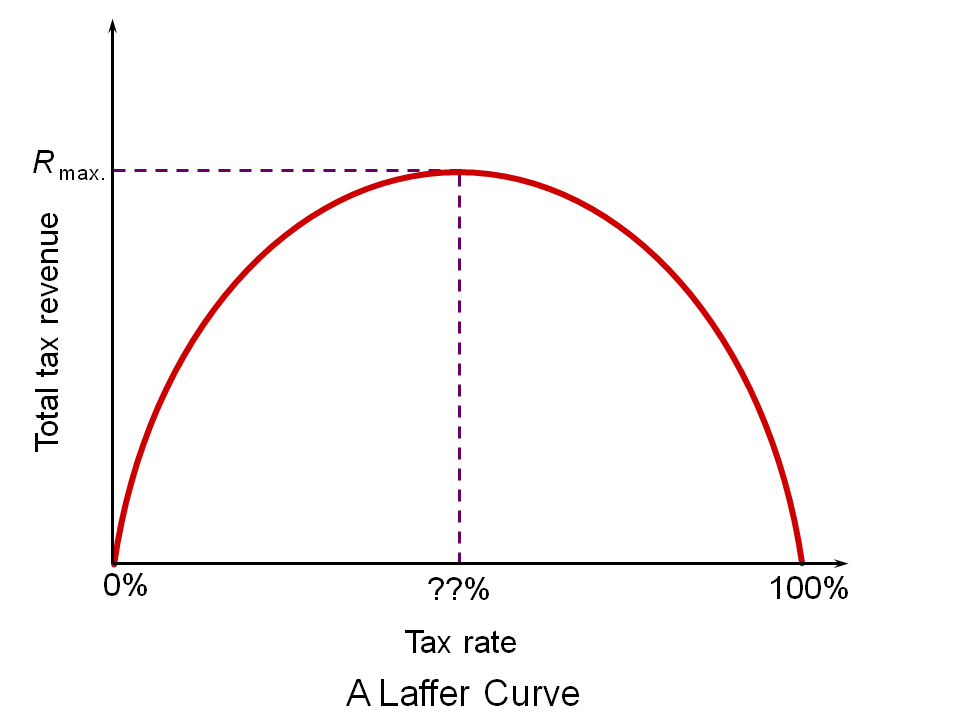
  • Laffer Curve - Theoretical relationship b/t tax rates and gov revenue
    • As tax rates increase from 0, tax revenues increase from 0 to some max point and then decline
    • Criticisms
      • Research suggests impact of tax rates on incentives to work, save, and invest are small
      • Tax cuts increase demand -> fuel inflation and demand can exceed supply
      • Economy's real location on curve difficult to determine

Thursday, April 7, 2016

Monetary Policy

Conducted by the FED; comprised of 3 tools

Reserve Requirement

  • Small % of deposit in bank, rest is loaned out (Fractional Reserve Banking)
    • Inc. in MS -> Inc. in amt of $ held in bank deposits
    • Recession - Dec. RR -> More ER; More loans; MS up, interest rates down; AD up (Easy)
    • Inflation - Inc. RR -> Less ER; Less loans; MS down, interest rates up; AD down (Tight)

Discount Rate

  • Interest rate FED charges to banks
    • MS up needs decrease in Dis. Rate (Easy)
    • MS down needs increase in Dis. Rate (Tight)

Open Market Op

  • FED buys/sells bonds (securities)
    • MS up needs buy bonds (easy)
    • MS down needs sell bonds (tight)

Easy monetary policy: Buy Bonds; Decrease Dis. R & RR

Loans increase; AD up; GDP up; MS up; Interest rates down

Tight monetary policy: Sell Bonds; Increase Dis. R & RR

Loans decrease; AD down; GDP down; MS down; Interest rates up

  • Fed Fund Rate - FDIC banks loan each other overnight funds (Opposite of Dis. Rate)
  • Prime Rate - Interest rate banks give to most credit worthy customers 

Countercyclical Policies: Keynesian Fiscal Policy vs. Monetary Policy

In the early 21st century, here in the USA, an efficient, "full employment" economy will probably have:
  • Annual unemployment rate 4%
  • Annual inflation rate 4%
If the economy goes into a recession:
  • The real GDP drops for at least 6 months
  • Unemployment rate increases to 6% or more
  • Inflation rate decreases to 2% or less
If Congress enacts Keynesian Fiscal Policies to attempt to slow/stop the recession, then:
  • The policy will try to improve C or G (parts of AD)
  • Congress will decrease federal taxes
  • Congress will increase job and spending programs
  • The federal budget will probably create a deficit
  • Due to changes in Money Demand, interest rates will increase (Crowding out might occur, but Keynesians don't care)
If the Federal Reserve employs Monetary Policy options to slow/stop the recession, then: 
  • The policy will target improvement in Ig (part of AD)
  • The Fed will target a lower Fed Fund Rate
  • The Fed can lower the discount rate
  • The Fed can buy bonds (Open Market Operations)
  • The Fed can (theoretically) lower the reserve requirement, but probably won't because it is too complex for the banks.
  • These Fed policies will lower the interest rates through changes in the Money Supply
  • These options should increase Ig
If the economy suffers from too much demand-pull inflation or cost-push inflation, then:
  • The unemployment rate will go to 4% or less 
  • The inflation rate will probably go to 4% or more
If Congress enacts Keynesian Fiscal Policies to attempt to slow/stop the inflation problems, then: 
  • The policy will try to decrease C or G (parts ofAD)
  • Congress will increase federal taxes
  • Congress will decrease job and spending programs
  • The federal budget will probably create a surplus
  • Due to changes in Money Demand, interest rates will decrease
If the Federal Reserve employs Monetary Policy options to slow/stop the inflation problems, then:
  • The policy will target decreases in Ig (part of AD)
  • The Fed will target a higher Fed Fund Rate
  • The Fed can increase the discount rate
  • The Fed can sell bonds (Open Market Operations)
  • The Fed can (theoretically) raise the reserve requirement, but probably won't because it is too complex for banks
  • These Fed policies will raise the interest rates through changes in the Money Supply
  • These options should decrease Ig


Graphs and Banking Systems

Demand Graph

  • Demand for money increase inverse w/nominal interest rate and quantity of money (Q decreases, I increases and vice versa)
  • Shifters: Change in
    • PL
    • Income
    • in taxation after investment

Money Supply

  • Affects AD when increased: -> r down, Ig up, AD up (Vertical)
  • Decreases - Goes Left: MS down, r up, Ig down, AD down

Financial Sector

  • Fin. Assets - Stocks and bonds provide expected future benefits
    • Benefits owner from issuer of asset meeting certain obligations
  • Fin. Liabilities - Incurred by issuer of fin. asset to stand behind issued asset
  • Interest Rate - $ paid to use fin. asset
  • Stocks - Fin. asset that represent ownership in a company
  • Bonds - Promise to pay $ and interest in the future

Banks

  • Fin. Intermediary - use liquid assets to fund investments of borrowers -> Fractional Reserve Banking
    • Liquid assets include currency in bank vaults and bank reserves
  • Banks create money by lending out deposits that are used multiple times
  • When a customer deposits cash or withdraws cash from their demand deposit account, it has NO EFFECT ON THE MONEY SUPPLY
    • It only changes...
      • The composition of money
      • Excess Reserves
      • Required Reserves
  • Changes in Money Supply for....
    • Single Bank
      • Loan money from ER
    • Banking System
      • ER x Money multiplier (1/RR) -> Total Money Supply
  • When the FED buys or sells bonds, ER is created

Basic Accounting Review

  • T-Account (Balance Sheet) - Lists assets and liabilities
  • Assets (Amounts owned) - Items claimed legally by bank; use of funds by fin. intermediary
    • Included in assets
      • Required Reserves - % of DD in vault
      • Excess Reserves - Remaining % of DD used for loans
      • Property - Statement of a bank's property values
      • Securities or Bonds - Previously purchased bonds held by the banks as investments
      • Loans - Previously loaned funds now owed back to the bank
  • Liabilities (Amounts owed) - Legal claims against a bank; sources of funds.
    • Included in liabilities
      • Demand Deposits - Cash deposits from the public to the bank
        • Part of MS if from person's cash holdings
        • Becomes new $ if from a bond -> MS up
      • Owner's equity or stock shares - Values of the bank stocks as held by the public
  • DD = RR + ER

Federal Reserve Banks

  • Functions
    1. Uses paper $
    2. Set reserve requirement and holds bank reserves
    3. Lends $ to banks and charges interest
    4. Check-clear service for banks
    5. Personal bank for government
    6. Supervises member banks
    7. Controls money supply in the  economy
  • Reserve Requirement - Fed needs banks to always have $ to meet demand
    • Amount = Reserve Ratio - % of DD locked to bank

Scenario 1

A private citizen takes cash that they possess and put it into a bank account
  • The cash placed into the bank is already part of the money supply
  • The deposit is counted as a bank liability
  • A % must be placed into required reserve
  • The remainder is placed into excess reserve
  • The bank will want to lend all of the ER, if possible
  • The amount in ER is multiplied by the monetary multiplier
  • This will be assumed to become new loans in the banking system
  • This will be counted as the change in money supply

Scenario 2

  • The Fed buys bonds back from the public
  • The public now has new cash
  • This new cash is new loans
  • Assume that the public puts the cash into demand deposits
  • A set percentage is placed into required reserve
  • The remainder becomes excess reserve
  • Excess reserve is multiplied by the money multiplier (1/RR)
  • This amount becomes new loans and is new money supply
  • The total change in money supply is the amount of demand deposits plus the new loan amounts

Scenario 3

  • The Fed buys bonds back from the member banks
  • The banks now have new ER
  • No money is needed to be placed in RR, since this is not owed to the public
  • All of these ER are multiplied by the monetary multiplier
  • This amount becomes new loans
  • This amount is the change in the money supply

Unit 4 - Money

Uses of Money

  • Medium of Exchange - Trade or barter
  • Unit of Account - Estimate economic worth in exchange process
  • Store of Money - Money holds value over period of time; products do not.

Types of Money

  • Commodity Money - Value from material type from which it was made.
    • Ex: Gold coins, silver
  • Representative Money - Paper money that represents tangible things which gives value
    • Ex: IOU
  • Fiat Money - Value declared by government 
    • Ex: U.S.  Money

Characteristics of Money 

  • Portable
  • Durable
  • Uniform
  • Scarce
  • Acceptable
  • Divisible

Money Supply

  • M1 Money = Currency (Cash and coins); Checkable deposits/accounts; traveler's checks
    • 75% of money; most liquid (convertible to cash)
  • M2 Money = M1 money + Savings Account; deposits held by foreign banks
    • Not as liquid
  • M3 Money = M2 money + Certificate of Deposit (CD) 
    • Early Penalty if drawn

Time Value

Is $ worth more today or tomorrow? TOMORROW

  • Because opportunity cost and inflation -> charge and pay interest
  • Simple Interest Formula = V = (1+P)^n x P
  • Compound Interest Fornula = V = (1+(r/k))^(nk) x P
    • V=Future value of $
    • P = Present value of $
    • r = Real interest rate as decimal
    • n = years
    • k = # of times interest is credited per year.

Sunday, March 27, 2016

Unit 4 Video Notes

Video 1

This video went over two aspects of money. It first talked about the types of money listed as commodity, representative, and fiat money. Commodity money is a thing that has an independent function without being used as money while representative money is something that represents a valuable metal. Fiat money is money backed by the government. Functions of money include being a medium of exchange, store of value and unit of account.  The first two functions mean to use money to purchase something and save it for later. The unit of account means that the price of a product implies its worth.

Video 2


  • The money demand slope is negative since the relationship between interest rates and quantity of money are inversely related. 
  • The money supply line is vertical because it is not affected by the interest rate. It can only change by the Fed. 
  • In order to control interest rates, the money supply has to be manipulated. 
  • Instability in interest rates leads to instability in investment and spending which leads to uncertainty in changes in aggregate demand.

Video 3

  • Reserve ratio is a tool of the Fed in monetary policy. 
    • Lowering it is seen in expansionary policy while raising the ratio is seen in contractionary policy. 
    • It is less used compared to other tools. 
  • The Discount Rate is another tool which is the interest rate the Fed charges to banks when the Fed lends out money. 
    • It works similarly to reserve ratio in how the Fed uses it. 
    • It does have a low impact. 
  • Bonds and Securities are another tool of monetary policy. 
    • Buying them is a part of expansionary policy while selling them is a part of contractionary policy. 
    • These actions fall under open market operations.
  • Federal funds rate works between fellow banks and not the Fed. It is the rate at which they borrow from each other.

Video 4

  • Loanable funds is the amount of available money that people can borrow. 
    • The demand for loanable funds is downward sloping just like the money demand slope. The supply of loanable funds is based on savings. 
    • The supply shifts based on peoples' incentive to save. 
  • Government deficit spending is shown by an increase in demand of loanable funds. To show an increase in interest rates, a decrease happens in the supply of loanable funds.

Video 5

  • The money creation process explains the spending in an economy. 
  • Money is created by making loans. 
  • The loan amount multiplied by the money multiplier shows how much money is created. 
  • In order to use the formula to find the amount of money created, the reserve requirement needs to be known. 
  • The process works assuming that banks hold no excess reserves. Otherwise, the final amount will decrease.

Video 6

  • Deficit spending affects the money market, the loanable funds market, and the aggregate demand and supply curve. 
    • The demand for money increases. 
    • The demand for loanable funds increases or the supply of loanable funds decreases.
    • Aggregate demand will increase.
  • A change in the supply of money influences the price level.
  • Fisher Effect - Interest rates and inflation change at the same rate. 

Thursday, March 3, 2016

Fiscal Policy

Fiscal Policy

  • The change in expenditures or tax revenue of the federal government
    • Can either increase or decrease taxes or spending

Types of Budget

  • Balanced Budget = Rev. = Expenditures
  • Deficit = Rev. < Expenditures
    • When in deficit, gov. borrows from
      • Individuals
      • Corporations
      • Financial institutions
      • Foreign entities and countires
  • Surplus = Rev. > Expenditures
  • Gov. Debt = Sum of deficits - sum of surplus
  • Discretionary (action) -
    • Expansionary when in deficit
      • Combats recession
      • Increased spendng; Decreased taxes
    • Contractionary when in surplus
      • Combats inflation
      • Decreased spending; Increased taxes
    • Increase/decrease gov. spending or taxes to get back FE (Fiscal policy response to economic problems)
  • Non-discretionary (wait)
    • Automatic or built-in stabilizers - include unemployment compensation and marginal taxes;  they happen without policy makers

Tax Systems

  • Progressive - Avg. tax rate rises with GDP (Tax revenue/GDP)
  • Proportional - Avg. tax rate remains constant as GDP changes
  • Regressive - Avg. tax rate falls with GDP
  • More progressive = more stability

Consumption and Saving and Multipliers

Disposable Income

  • The income after taxes [Gross - Taxes]
  • Consume or save (Spend or not spend)
  • Consumption - Restricted by DI & propensity to save
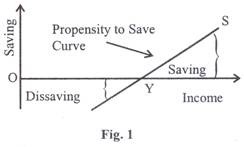
    • If DI = 0, autonomous consumption and dissaving

  • Saving - Restricted by DI & propensity to consume
    • If DI = 0, no saving

  • APC/APS = Average propensity to consume/save
    • APC + APC = 1
    • 1 - APC = APS
    • 1 - APS = APC
    • -APS or when APC > 1 -> Dissaving

Multipliers

  • MPC + MPS = 1
  • MPC = 1- MPS
  • MPS = 1 - MPC
  • MPC
    • Marginal ... Fraction of any change in DI consumed 
    • (Change in Consumption/Change in DI)
  • MPS
    • Fraction of DI saved
    • (Change in Saving/Change in DI)
  • Spending Multiplier Effect
    • Initial change in spending; causes larger change in AS or AD
    • (1/(1-MPC)) or 1/MPS
    • Multiplier = (Change in AD/Change in C, Ig, G, or Xn)
    • Positive is increase; Negative is decrease
  • Tax Multiplier
    • Reverse multiplier because it leaves circular flow
    • Tax cut is positive because money enters circular flow
    • Always negative
    • -(MPC/(1-MPC)) or -(MPC/MPS)
    • Multiplier = (Change in AD/Change in C, Ig, G, or Xn)

Classical vs. Keynesian

Classical 

  • Followers
    • Adam Smith
    • J.B. Say
    • David Ricard
    • Alfred Marshall
  • Say's Law
    • Supply creates own demand
    • Production = Income = Spending
    • Underspending unlikely
    • Whatever output produced will be demanded
  • Savings and investment
    • Savings = Investment income
    • Savings (Leakage) = Investment (Injection)
  • Loanable Funds Market

    • Wage/Price Flexibility
      • Downward
    • Supply Curve
      • Vertical
    • Output and Employment
      • Determined by AS
    • Unemployment
      • Rarely exists because of wage/price flexibility
      • Cause: external (war)
    • Aggregate Demand
      • Determines PL
      • Stable if money supply is stable
    • Basic equation
      • MV = PQ
      • 1965 - 1972
    • Role of government
      • Monetary policy maintains steady money supply
      • Laissez-faire is best
      • Self regulating economy
    • Inflation
      • Too much money
    • How long the short run is
      • Short time
    • Emphasis today
      • Microeconomics
    • Other
      • Competition is good
      • Invisible Hand
      • Long run - Balance @ FE
      • Trickle-Down effect - Help rich 1st, everyone else 2nd

    Keynesian

    • Followers
      • J.B. Keynes
    • Say's Law
      • Depressions refute Say's Law
      • Demand creates own supply
      • Underspending persists
    • Savings and investments
      • Savings not equal to investment
        • Different motivations
          • Savings
            • Future needs
            • Precaution
            • Habit
            • Income level
            • Interest rate
          • Investment
            • Interest rate
            • Rate of profit
            • Expectations
    • Loanable Funds Market
      • Investment from savings, cash, checking accounts
      • Lending creates money -> Supply of money increases
      • Inflation and unemployment are unstable
    • Wage/price inflexibility
      • Prices and wages inflexible downward
        • Ratchet effect
    • Supply curve
      • Horizontal
    • Output and Employment
      • Determined by AD
    • Unemployment
      • Usually exists
      • Causes:
        • External (war)
        • Internal (Savings not equal to investment
    • Aggregate Demand
      • Changes due to determinants
      • Unstable even if money supply is stable due to fluctuations in investment spending
    • Basic equation
      • C + Ig + G + Xn 
      • 1973 - Present
    • Role of Government
      • Fiscal Policy - Tax and spend
      • Active government
      • Economy is not self regulating
    • Inflation 
      • Too much demand
    • How long the short run is
      • Long time
    • Emphasis Today
      • Macroeconomics
    • Other
      • Flawed competition
      • AD is key; not AS
      • Leaks + Savings = Recession
      • Ratchet effects and Sticky Wages block Say's Law
      • We are doomed in the long run

    Investment Demand


    • Investment - $ spent/expenditures on new plants/factories, capital equipment, technology, new homes, inventory.

    Expected Rates of Return

    • Invest based on cost/benefit analysis
    • Benefits from expected rate of return
    • Cost from interest costs
    • Amount of investment from comparison of expected rate of return to interest cost
      • Exp return > Interest Cost = Yes
      • Exp return < Interest Cost = No
    • r% vs. i%
      • Nominal = observable rate of interest; Real takes out inflation, known ex post facto
      • r% = i% - pi% -> bases investment decision

    The Curve

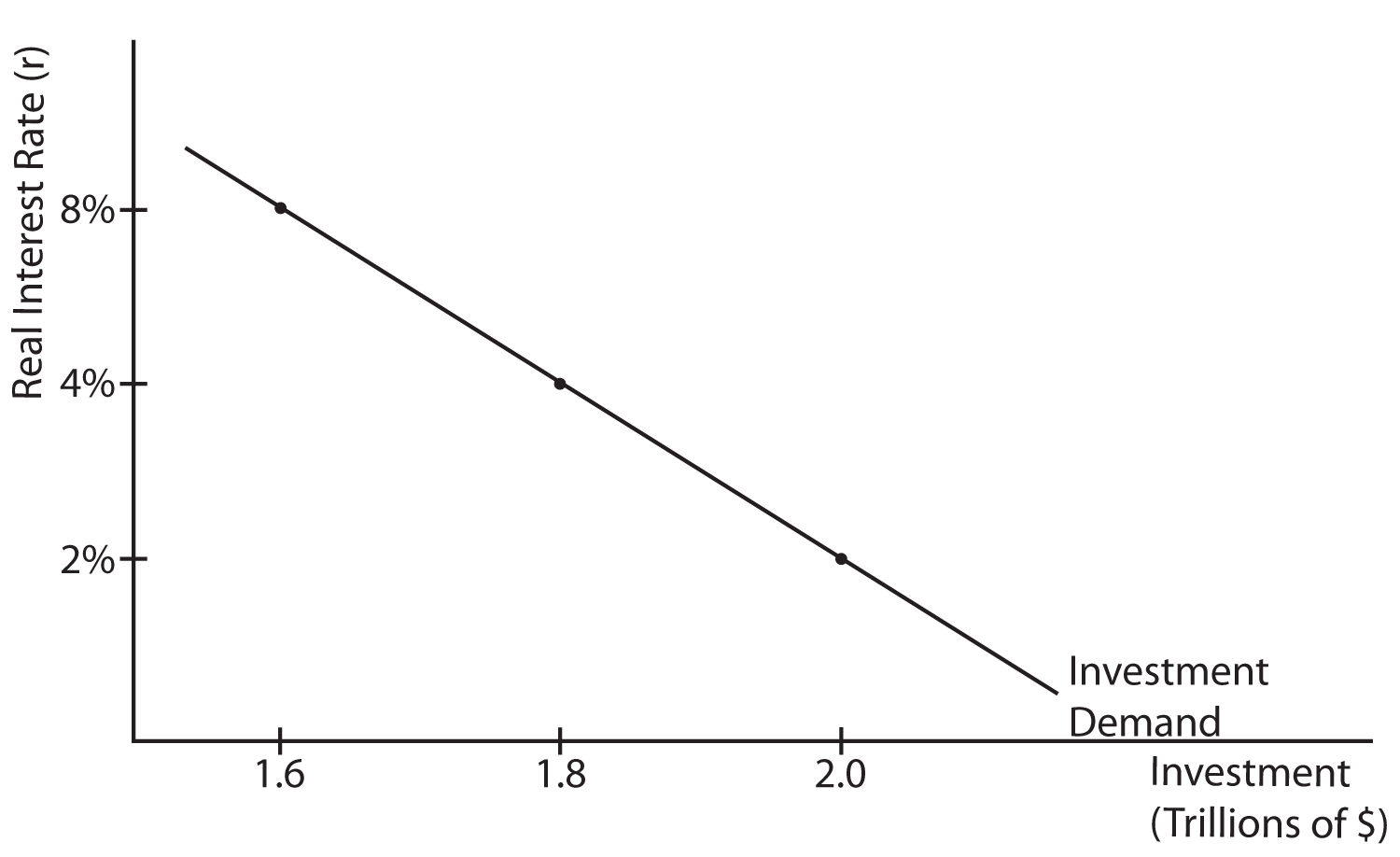
    • Downward sloping because high rates = less investment, vice versa
    • Shifts 
      • Cost of production 
        • Low = right
        • High = left
      • Business Taxes
        • Low = right
        • High = left
      • Tech Change
        • New = right
        • Lacking = Left
      • Stock of Capital
        • Low = right
        • High = Left
      • Expextations
        • Positive = right
        • Negative = left
    Image 6.07. This graph is placed depicts the X axis as Investment (Trillions of Dollars). The second graph's Y axis is labeled as Real Interest Rate (r). There are three labeled values on the X axis and three labeled values on the Y axis. On the X axis, the closest value to the origin is labeled 1.6. The value to the right of the first is labeled 1.8. The third value, which is farthest from the origin, is labeled 2.0. On the Y axis, the closest value to the origin is labeled 2%. The second value, which is located above the first, is labeled 4%. The third value, which is the farthest from the origin, is labeled 8%. A line with a decreasing slope is labeled Investment Demand. This line has three specific coordinates, which are (1.6, 8%), (1.8, 4%), and (2.0, 2%).

    Aggregate Supply

    Aggregate Supply

    • The level of real GDP that firms produce at each price level
      • Long Run - Period where input $ are flexible & adjust to change in PL
        • Real GDP is independent to PL
      • Short Run - Input prices are rigid; they do not adjust 
        • Real GDP related to PL
    • LRAS - Shows full employment (analogous to PPC)
      • Vertical @ full employent

    Changes in SRAS

    • An increase is represented as a shift to the right
    • A decrease is represented as a shift to the left.
    • Changes are based on cost of production per unit (Total input cost/total output)
    • Determinants:
      • Input Prices
        • Domestic resources $ [75% on wages, Capital cost, Raw material]
        • Foreign resource $
        • Market Power ... Increase shifts left; Decrease shifts right
      • Productivity - (Total output/total input)
        • More productivity -> Low unit prod. $ -> SRAS shifts right
        • Less productivity -> High unit prod. $ -> SRAS shifts left
      • Legal Institution Environment
        • Taxes & Subsidies 
          • Taxes shift SRAS left
          • Subsidies shift SRAS right
        • Gov. regulation
          • Regulation causes cost of compliance = SRAS <-
          • Deregulation reduces compliance costs = SRAS->
    • FE equilibrium occurs when AD crosses SRAS & LRAS @ same point

    • Recessionary Gap - Occurs when equilibrium is below FE output
    • Inflationary Gap - Equilibrium is above FE output
    • SRAS 
    undefined
    • Nominal Wages - Amount of $ received by worker per unit of time
    • Real Wages - Amount of goods/services worker can buy with nominal wages
    • Sticky Wages - Set nominal wages from initial price levels
      • Does not vary because labor contracts etc.

    Aggregate Demand


    Aggregate Demand

    • Aggregate Demand - Demand by consumers, businesses, government, and foreign countires
      • Change in price = Move along curve
      • AD = C + I + G + Xn
    • The curve is a downward slope because:
      1. Real Balance Effect: Higher price -> Less purchase power of $
        1. Reduced quantity of expenditures
        2. Lower price levels -> Higher purchase power and expenditures
      2. Interest Rate Effect: Higher price level -> Higher interest rates -> Less spending & investment
      3. Foreign Trade Effect: US price level increase -> Foreign buyers buy less U.S and Americans buy foreign.

    Determinants of AD

    • Shifters = Expenditure approach of GDP
      • Includes
        • Change in C, I, Ig, Xn
        • Multiplier that produces greater change than original in 4 comp.
      • AD up = Right  :  AD down = Left
    • Consumption: Affected by-
      • Consumer Wealth - Right if more; Left if less
      • Consumer Expectations - Positive goes right; Negative goes left
      • Household Indebtedness - Right if less; Left if more
      • Taxes - Right if less; Left if more
    • Gross Private Investment: Affected by:
      • Real Interest Rate - Right if lower; Left if higher
      • Expected Returns - Right if higher; Left if lower
        • Influenced by: 
          • Profit Expectations 
          • Technology
          • Degree of excess capacity
          • Business taxes
    • Government Spending:
      • More leads to right
      • Less leads to left
    • Net Exports: Affected by - 
      • Relative Income
        • Strong foreign economy -> More exports -> Right
        • Weak foreign economy -> Less exports -> Left
      • Exchange rates
        • Strong $ -> More imports; Fewer exports -> Left
        • Weak $ -> Less imports; More exports -> Right

    Tuesday, February 9, 2016

    Nominal & Real GDP

    Nominal GDP

    • Value of output produced in current prices

    Real GDP

    • Value of output produced in constant or base year prices
    • Adjusted for inflation

    Base Year

    • Either the earliest year or given
    • Nominal = Real when it is base year
    • After; Nominal > Real
    • Before: Real > Nominal

    GDP Deflator

    • Price Index used to adjust from Nominal to Real
      • Base Year: Deflator = 100
      • After: Deflator >100
      • Before : Deflator < 100
    • Calculated by (Nominal / Real) x 100

    Consumer Price Index

    • Common measure of inflation; measures cost of market basket of goods for average family
    • Calculated by:
      • (Market $ in given year/Market $ in base year) x 100

    Inflation

    • Calculated by:
      • (New PI - Old PI)/(Old PI) x 100

    GDP Fundamentals

    GDP 


    • Total dollar value of all final goods and services produced within a countries borders within a given year
    • Included in GDP:
      •  Consumption - 65%
        • purchased finished goods and services
      • Ig (Gross Private Domestic Investment) - 17%
        • factory equipment maintenance
        • new factory equipment
        • new construction housing
        • unsold inventory of products built in a year
      • Government Spending - 20%
        • School District counted 
      • Net Exports - -2%
        • Exports - Imports = Net Exports
    • Not Included in GDP:
      • Intermediate Goods - Not final, but in process
      • Secondhand Goods -  To avoid double counting
      • Purely Financial Transactions (stocks & bonds)
      • Illegal Activities (drugs)
      • Unreported business activities (unreported tips)
      • Transfer payments
        • Public (SS, VA, welfare)
        • Private (Scholarships)
      • Non-market activity (Volunteering, babysitting, solo work)

    Calculating GDP:

    1. Expenditure Approach:
      • C  +  Ig  +  G  +  Xn  =  GDP
      • Add all spending on final goods and services provided in a given year.
    2. Income Approach
      • Add all income resulted from selling final goods and services produced in a given year.
      • Rarely used b/c dishonesty
      • W  +  R  +  I  +  P  +  Statistical Adjustments  =  GDP
        • Where:
          • W = Wages
          • R = Rent
          • I = Income
          • P = Profits/Proprietor's Income
    • Compensation of employees: Wages/salaries, Wage/salary supplements (pensions, health ins., welfare)
    • Rent: Income received by households and businesses that supply property resources
    • Interest: Money paid to suppliers of loans (owe interest + principal)
    • Proprietor's Income : Sole proprietorship and partnerships have
    • Corp. Profits: Inc. Dividends, corp. income tax, undis. corp. profits
    • Statistical Adjustments: Indirect business taxes; consumption of fixed capital (depreciation); net foreign factor payment

    GNP

    • Total value of all final goods and services produced by a country in a year whether on or off its land.

    Unemployment

    Unemployment

    • Failure to use available resources, esp. labor, to produce desired goods and services.
    • Labor Force - 16+, willing to work, employed, unemployed
      • Excluded: 
        • Military
        • Homemakers
        • Retired
        • Disabled
        • Asylum People'
        • Incarcerated
        • Students
        • Those not looking for work
    • Unemployment Rate - 4-5% = Full or natural unemployment; NRU
    • Calculated by:
      • [# of unemployed/labor force] x 100

    Types of Unemployment

    1. Frictional
      • People job searching; temp. unemployed or between jobs; have transferable skills
        • Ex: HS/College grad.; Job prospectors
    2. Structural
      • Changes in structure of labor force obviates skills; no transferable skills.
    3. Seasonal
      • Due to season and nature of job
        • Ex: Bus drivers, Santa; Easter Bunny; Lifeguards; Construction
    4. Cyclical
      • Results from economic downturns i.e. recessions; as demand for goods and services fall, demand for labor fall and workers are laid off
    • NRU = Frictional + Structural
      • No Cyclical 

    GDP Gap

    • Amount by which actual GDP falls short of potential

    Okun's Law

    • For every 1% that actual unemployment exceeds NRU, GDP gap of 2% occurs

    Rule of 70

    • Determines amount of years to take for value to double given a particular annual growth rate.


    Other Inflation

    Interest Rates: Nominal v. Real

    Nominal

    • Not adjusted for inflation
    • % increase in money paid to lender for use of borrowed money
    • Real Rate of Interest + Inflation Premium 

    Real 

    • Adjusted for inflation
    • % increase in purchase power lender receives when borrower repays loan with interest.
    • Nominal Interest Rate - Inflation

    Effects of Inflation

    Hurt by Inflation
    • Fixed income
    • Savers
    • Lenders/creditors

    Helped by Inflation
    • Borrowers
    COLA - Cost of living adjustment - Wages increase when inflation occurs

    Extra Calculations with GDP

    Budget

    • Gov. Purchases + Gov. Transfer Payments - Gov. Tax and Fee Collections
    • [+] = Deficit
    • [-] = Surplus

    Trade

    • Exports - Imports
    • [+] = Surplus
    • [-] = Deficit

    National Income

    1. Compensation + Rent + Interest Income + Proprietor's Income + Corp. Profits
    2. GDP - Ind. Bus. Tax - Depreciation - Net Foreign Factor Payment

    Disposable Personal Income

    • Nat, Income - Per. Household Tax + Gov. Transfer Payments

    Net to Gross

    • Net (Domestic/National) + Depreciation = Gross (Domestic/National)
    • Gross (Domestic/National) - Depreciation = Net (Domestic/National)

    GNP

    • GDP + Net foreign factor payment

    Circular Flow Diagrams

    A circular flow diagram represents various transactions in an economy

    Components include:

    • Household - Group/person that shares income
    • Firm - Business that produces goods and services for sale
    • The government

    The Markets

    • Factor/resource - Households sell resources and firms buy those resources
    • Product - Firms sell products and households buy products

    Sunday, January 24, 2016

    Business Cycles


    • 1 cycle occurs from trough to trough
    • Cycle avg. 5 - 7 years
    • Recessions last approx. 14 months
    • Peaks and troughs meaningless b/c we never know we are in one until its over
    • Trough = end of recession
    • Recession lose >10% of real GDP -> Depression
    Peak - Highest point of real GDP; shows max amount of spending and min unemployment; inflation is a problem.

    Expansion (recovery) - Real GDP up b/c of increase in spending and decrease in unemployment.

    Contraction/Recession - Real GDP down for 6 months; unemployment up & spending down

    Trough - Lowest point of Real GDP: max unemployment and min spending

    Supply and Demand

    Demand


    Demand is the quantities that people are willing and able to buy at various prices

    Law of Demand - Inverse relationship between price and quality demanded
    • Change in price changes the change in quantity demanded
    Causes of change in demand
    • Change in...
      • buyers' taste
      • # of buyers
      • income
        • Inferior goods - increase in income -> decrease or no change in demand
        • Informal goods - increase in income -> increase in demand
      • price of related goods
        • Complementary goods - goods that pair well
        • Substitute goods - replacement for similar goods
      • expectations

    Supply


    Supply is the quantities that producers or sellers are willing and able to produce at various prices

    Law of Supply - Direct relationship between $ and quantity supplied
    • Change in price causes a change in quantity supplied.
    Causes of change in supply
    • Change in...
      • weather
      • tech
      • cost of production
      • # of sellers
      • taxes/subsidies
      • expectations
    Why the curve moves left
    • Supply down
    • Increase in cost of production
    • Technology down
    • Taxes up
    • Subsidies down
    • # of sellers down
    • Weather conditions are worse
    Why the curve moves right
    • Supply up
    • Cost of production down
    • Technology up
    • Taxes down
    • Subsidies up
    • # of sellers up
    • Weather conditions are good

    Elasticity of Demand


    • Elasticity of Demand - Measure of consumers' reaction to price changes
      • Elastic - Sensitive demand from price change; E > 1; Not a necessity, some substitutes
        • Ex: sodas, steaks, candy, fur coats 
      • Inelasic - Demand not vulnerable to price change; E < 1; necessary product; few to no substitutes; always bought
        • Ex: Insulin/Medicine, Salt, Gas, Milk
      • Unit/ary - E = 1
    Calculation
    1. Quantity - (New Q - Old Q) / Old Q
    2. Price - (New $ - Old $) / Old $
    3. PED - % change Q dem./ % change $ = |PED|


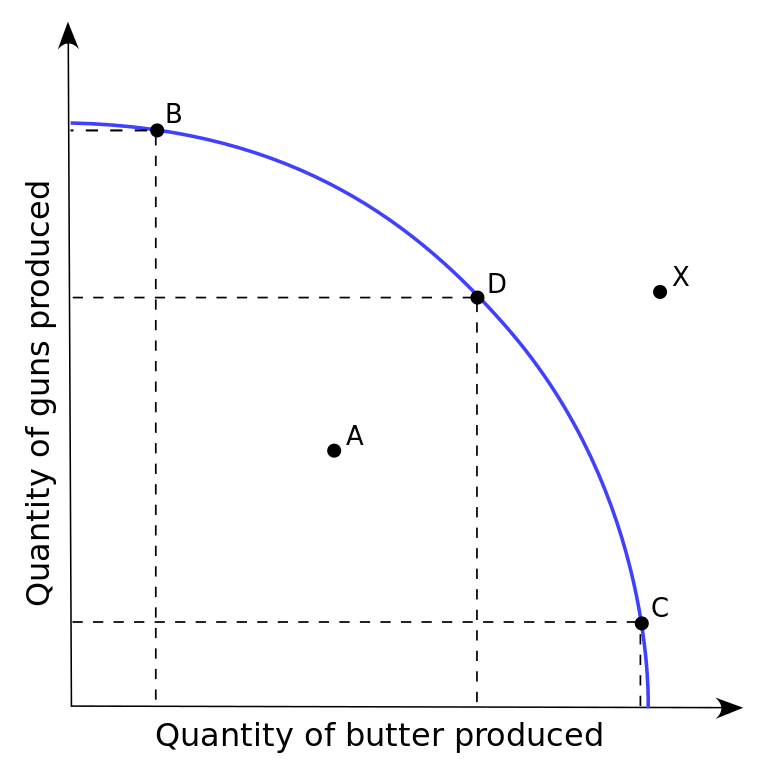
    Production Possibilities Curve

    B, D, C - Attainable and efficient
    A - Attainable yet inefficient (underutilization)
    X - Unattainable in current state

    Also known as the PPC, PPF, or PPG

    The PPC shows alt. ways of resource usage

    4 Assumptions
    1. 2 goods
    2. Fixed resources
    3. Fixed technology
    4. Full employment of resources
    Efficiency
    • Efficiency - Max usage of resources; little wasted
    • Allocative - Products produced most desired by society
    • Productive - Products produced w/ least cost; any point on curve
    • Underutilization - Using fewer resources than economy's capability
    Movements of the PPC
    1. Inside PPC - when resources are unemployed
    2. Along PPC - on curve
    3. Shifts of PPC
      • Increase - graph moves ->
      • Decrease - graph moves <-
    Causes of Shift
    1. Tech change (Out)
    2. Resource change (Out)
    3. Economic growth
    4. Natural disasters/war/famine (In)
    5. Labor change (In)
    6. Increase in education & training (Human capital) (In)

    Unit 1 Miscellaneous

    Macro vs. Micro

    • Macroeconomics - Study of economics as whole {International trade, Supply and Demand, and minimum wage}
    • Microeconomics - Study of individual/specific units of economy {Market struc., Business org.}


    Positive vs. Normative Economics

    • Positive - Tries to describe current world, descriptive; "What is...", Collects and presents facts
    • Normative - Tries to prescribe expectations of the world; represented by "ought" and "should"


    Needs vs. Wants

    • Needs - Basic requirements for survival

      1. Food
      2. Water
      3. Shelter
      4. Clothing

    • Wants - Desires of citizens


    Goods vs. Services

    • Goods - Tangible commodities

      • Capital goods - Materials for other goods (trucks, machinery, factories) 
      • Consumer - Final product to be used by customer
    • Services - Work performed for someone

    Scarcity vs. Shortage

    • Scarcity - Fundamental economic problem society faces; how to satisfy unlimited wants w/ resources.
    • Shortage - Quantity demanded > Quantity of supply

    4 Factors of Production
    1. Land 
    2. Labor
    3. Capital
      • Physical - Tools, buildings, factories, machinery
      • Human - Skills, abilities, intellect, talent
    4. Entrepreneurship - (Req innovation and risk taking)
    Trade-offs - Alt. we give up whenever we choose something over another
    Opportunity cost - Next best alt. what to give up
    Total revenue - Total $ a firm receives from selling
    Fixed cost - Cost resistant to change no matter the amount produced

    • Ex: mortgage, rent, salary, insurance
    Variable cost - cost rises/falls based on # produced. Ex: Bills
    Marginal cost - cost of producing one more unit.